On building a framework for working with coding agents
why you should build your own tools in 2026
tooling claude-code
Introduction
Over the past few months I have been using claude-code extensively to do development. After trying tools like Cursor, OpenCode and Antigravity, I decided to finally settle with claude code and build my complete workflow around it. Majorly because of the configurability and constant updates.
Now to be fair,
Since the playground is changing fast, its better to be agent agnostic. With this principle in mind, I tried to create a higher level framework for managing agents which run on terminal. Claude code being the primary one but not just limited to it. The framework should allow changing the agent without any large overhead.
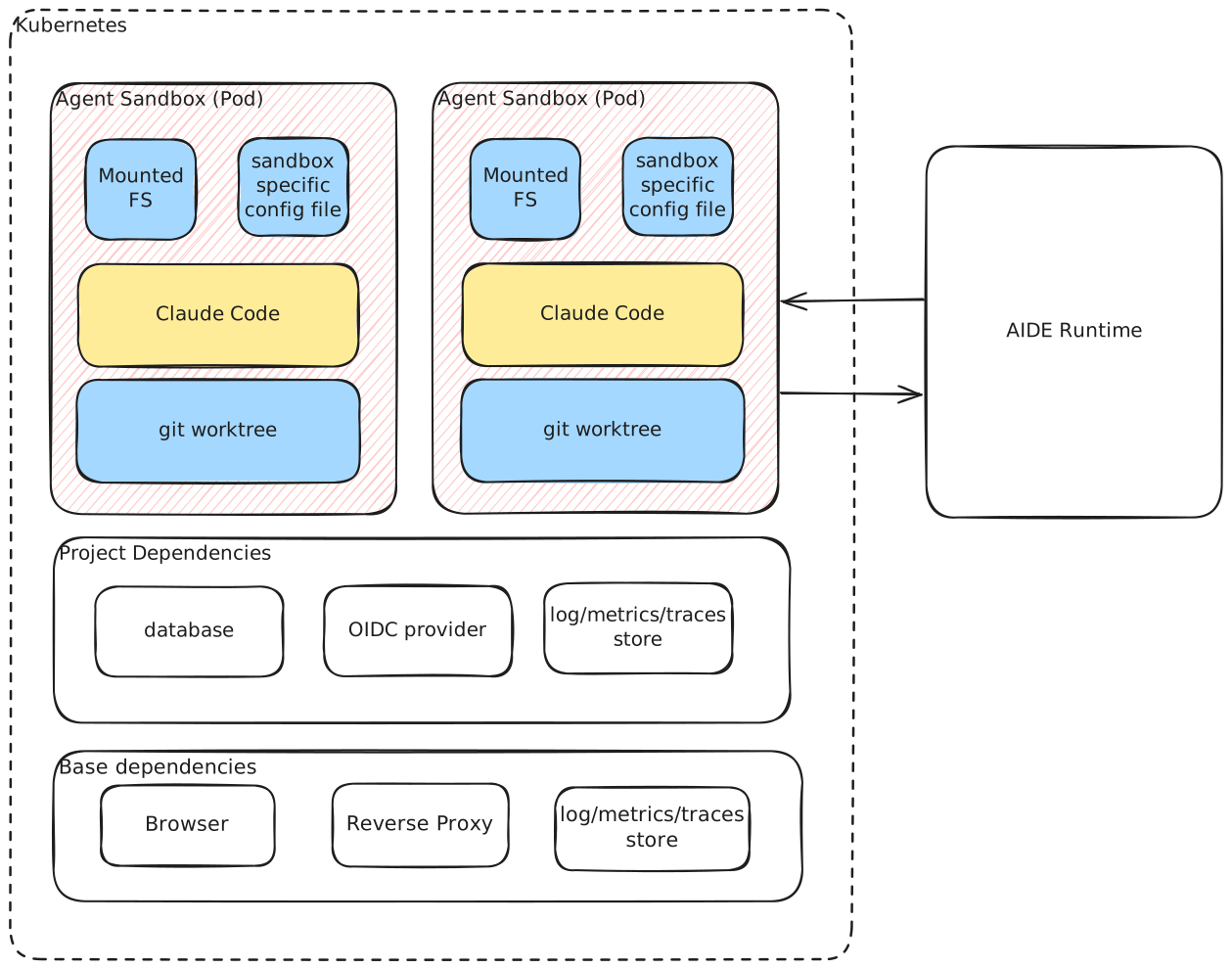
The framework provides:
- Sandbox: Allows the agent to run in bypass permissions mode, which reduces the dependence on the user to click allow all every time the agent does something new. The containers are root less by default hence they are much safer.
- Shared data folder for agents: Useful for sharing memory/chats across sandboxes
- Shared base dependencies: Useful for sharing the components like Database instances, OIDC provider and browser ( useful for chrome devtools mcp / playwright mcp) between sandboxes to reduce resource consumption. All containers are on a shared network which allows them to communicate with each other and reuse dependencies.
- Native reverse proxy: This allows access to multiple instances of your application being build in the container from the host system. This can be done with orbstack network or k8s service too.
Not having control over the agent internally is limiting but provides a strategic advantage while the waves are still roaring everyday with new tech around LLMs.
Goal of the framework
Eventually my goal with the framework is to identify patterns in everyday development, convert them into deterministic modules if possible and eliminate out the agent from the workflow. Eventually be independent of the agent to read the codebase for me and then suggest me changes. I am not building this framework for agents but for humans who use agents to do more. That, I believe happens via clear separate of concern.
In his famous book "Thinking fast and slow", Daniel Kahneman argues that thinking is a play between two systems. System 1 is intuitive and cheap, while System 2 uses reasoning and is expensive. I think the future of software engineering is at a cross road where agents are good at enacting being system 1 but are really really expensive trying to be system 2. So for now, my goal is the keep System 2 for myself and have agents do the intuitive chore work while notifying the user to step in when things get tough. Ofcourse, the framework is no where near there but hopefully it will be there soon.